

Writing killer sales and marketing emails is more difficult than you might expect.
You need to ensure your emails are arriving in your audience’s inbox with purpose – why are you getting in touch with me?
There are many ways to improve the emails you’re sending to potential customers/clients. In this guide, we’re running through everything you need to know to improve your business’ email writing, helping marketers, business owners and sales professionals to drive and convert more leads.
If you want to grow your business, then email marketing is a key element you can’t ignore.
The difference between email writing for B2B and B2C businesses
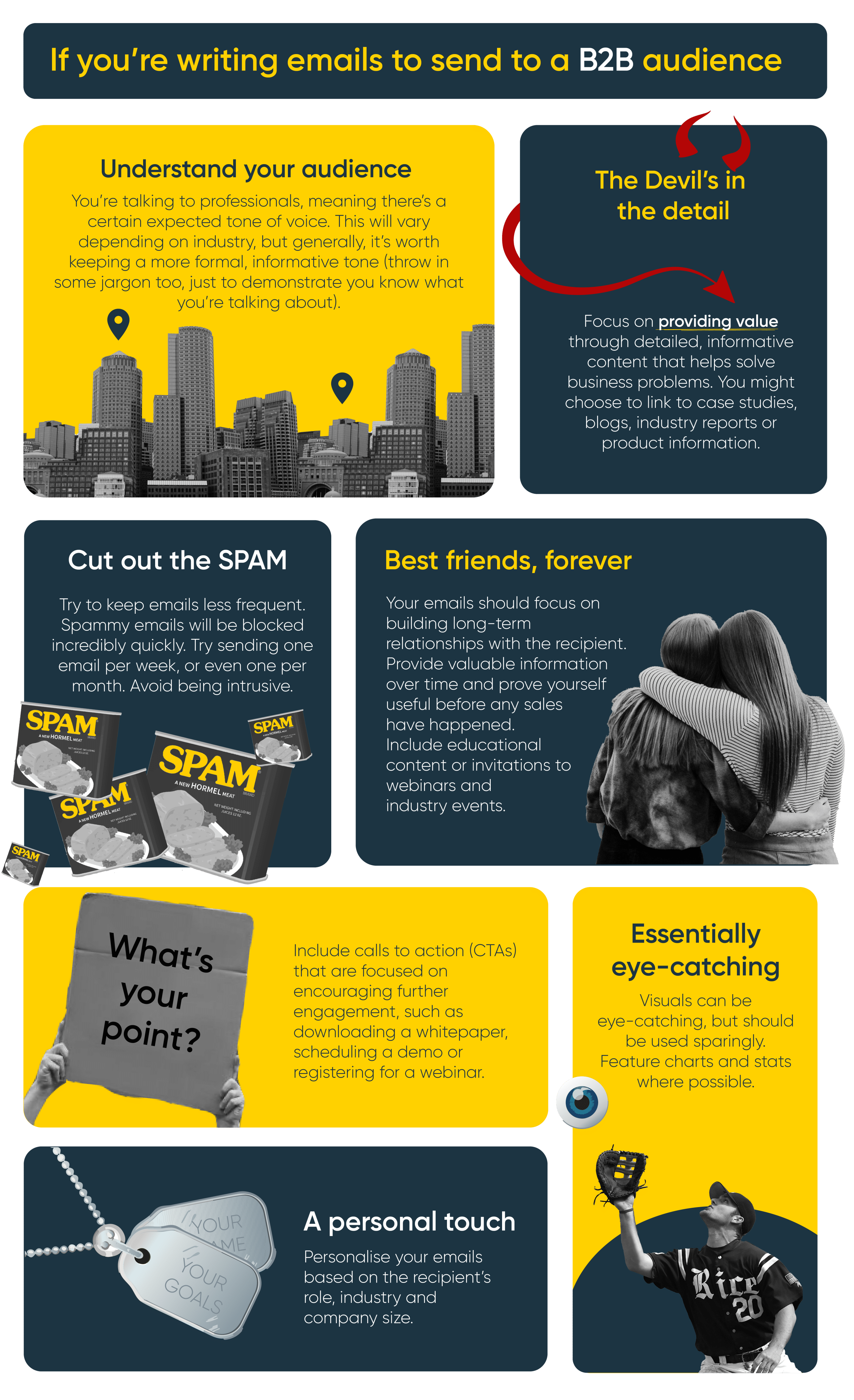
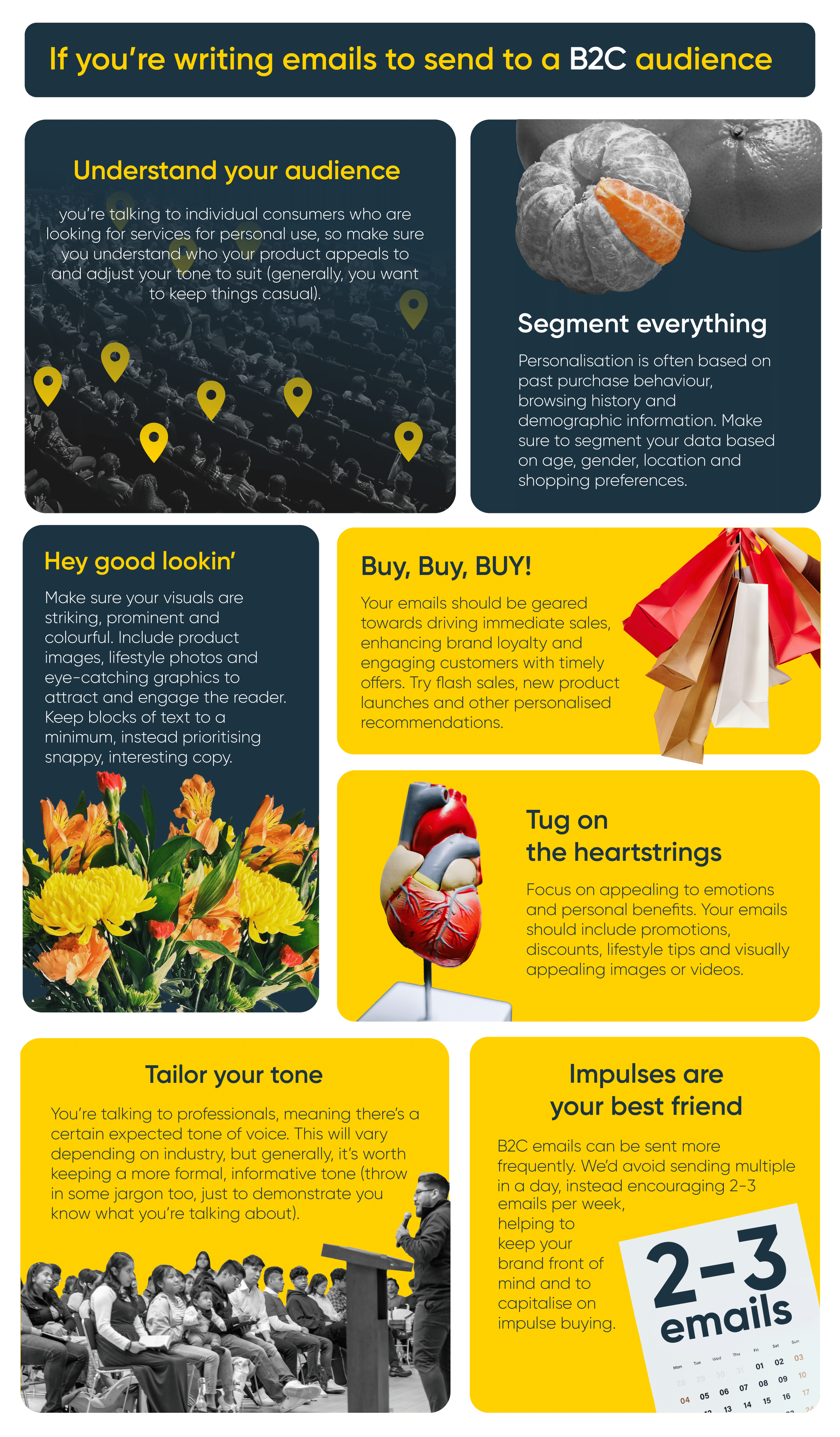
When writing sales/marketing emails, understanding your audience is key.
How to build a strong email strategy
We find that many businesses operate under a ‘random’ email strategy… meaning that they have no email strategy, instead choosing to randomly send out marketing emails as and when they have time.
This is rubbish.
Random emails do not work, you need structure. An email writing strategy allows you to have a better idea of what you’re sending, when you’re sending and, most importantly, why you’re sending emails.
Step 1: set goals
What are your emails meant to achieve? Are you expecting them to directly drive sales, or do you want to nurture a prospective sale?
This will depend on where in the funnel your prospective customers/clients are. We recommend running multiple email campaigns that are designed to target people at different stages of your funnel, this ensures you’re covering all bases.
Step 2: identify audience needs
You should understand your audience’s pain points – what problems do you solve?
Map these out and ensure you have emails that address each and every pain point. Stress exactly how you solve customer/client problems (make sure to collate relevant stats at this stage, too).
Step 3: plan and write your content
Develop a content calendar (don’t neglect this, without a calendar, you will forget and fall behind). Your content calendar keeps everything on track and on time.
We highly recommend having other content prepared for your emails to link to. Blogs, infographics, guides, videos – all of this will help add substance to your emails, meaning you’re not just emailing asking for sales. Make sure you’re providing something for free; sales will come naturally in time.
How to build up your email list
Building a robust email list is essential if you want your email campaigns to be successful. Here’s some ideas for how you can grow your email list:
- Create valuable gated content – This is content that a visitor needs to sacrifice their email to access.
- Optimise signup form locations – Ensure your website has signup forms prominently on your key pages that your desired audience views.
- Leverage social media – Run contests or giveaways on your social channels where entering requires an email address.
- Host webinars and events – Request that each attendee provides their email address to sign up for any webinars and events.
- Use referral programmes – Encourage existing customers to promote your brand by offering rewards or discounts for successful referrals.
- Collaborate with partners – Partner with complementary businesses to host webinars or hold giveaways.
- Use exit intent popups – Offer a discount or offer when someone is about to leave your website.
- Optimise your website for mobile – Make sure your website and forms are easily used on mobile.
- Run paid ad campaigns – PPC (pay per click) campaigns are a great way for you to drive traffic to dedicated landing pages designed for data capture.
- Guest blog on other websites to build awareness – Featuring your content on other business’ websites is a fantastic way for you to build brand awareness.
Tips for crafting the perfect sales/marketing email
77% of marketers report seeing an increase in email engagement over the last 12 months. Email is still an incredibly useful lead generation tactic – here’s how you improve your emails and craft the perfect sales/marketing emails:
Subject lines
Your subject lines should be kept between 30-50 characters, or 4-7 words. Any longer than this and they may not display properly on every device.
Keep your subject lines short, concise and engaging.
Also, make sure it doesn’t sound like a sales email. Nothing gets sent to the bin faster than an email with a ‘Hi, I want to chat’ subject line. We highly recommend ensuring that your subject lines focus on the reader, addressing a pain point they have to demonstrate you know what you’re talking about. For example:
A poor subject line might read ‘Amazing software makes it EASY to build better email lists!’
A much better subject line might read ‘Finding it hard to build an email list?’
Keep it relatively low key, avoid clickbait and avoid certain buzzwords like ‘sale’, ‘cheap’ or ‘buy’, as these are often picked up by spam filters.
Personalisation
Modern CRMs like HubSpot allow you to automatically personalise emails. No more manually entering names into emails you’re sending!
Featuring a recipient’s name (‘Hi Mark’ rather than ‘Hi there’) can improve email open rates by 26%. You might also choose to feature their business name, if you’re writing B2B emails.
Email copy
Generally speaking, you should keep your email copy concise.
Nobody wants to sit and read an essay that’s landed in their inbox, they want to know:
- Why you’re emailing them
- What benefits do you provide
- Why should they care?
Grab the reader’s attention, provide some unique or useful information, include a call to action then end your email. Don’t overcomplicate it, don’t linger too long.
Design and layout
Modern email design is incredibly important.
Information should be easily accessible and fully legible. Keep your designs as simple but effective as possible – you want to use design to guide your recipient towards your CTAs.
It’s also imperative that your email designs are optimised for mobile. We have seen literally hundreds of marketing emails that do not render properly on mobile. They look rubbish and will immediately turn off your reader.
Types of emails for both B2B and B2C businesses
Your audience will affect the types of emails you should be creating.
Common types of emails for B2B businesses
-
- Newsletters – Link to blogs, business updates and keep your audience generally up to date.
- Product updates – Shout about new products, features and updates.
- Event invitations – Whether you’re running a webinar or attending an event, make sure your audience know about it!
- Industry insights and reports – Your business should provide the expert voice, keeping them posted on what’s happening in your industry.
- Remarketing emails – Ads that target people who have visited your website, but ultimately bounced.
Common types of emails for B2C businesses
- Promo emails – Got a new sale on, or need to shift excess stock? It’s time for a promo email!
- Welcome series – Emails shouldn’t stop when a customer converts. Set up an automated welcome email series that answers all customer questions (this can also be relevant to B2B)
- Abandoned cart – Abandoned carts are so close to converting. A carefully planned abandoned cart email may well just bring someone back in to convert. You might choose to include a discount to entice them back.
- Remarketing emails – Ads that target people who have visited your website, but ultimately bounced.
Crafting great calls to action (CTAs) when writing professional emails
Customised CTAs convert 42% more visitors when compared to vague or generic CTAs.
We recommend leading any CTA with a verb. If you’re desperately thinking back to your high school English lessons, don’t worry – a verb is a ‘doing word’, so ‘buy’, ‘learn’, ‘join’, ‘discover’, et cetera.
Start with a verb, then customise your CTA based on the context of your emails. Say your email’s aim is to get someone to read a blog all about making better ice cream.
A poor CTA might be: ‘Blog here’.
A much better CTA would be: ‘Master ice cream making’.
More engaging, more tantalising. It’s also an opportunity for you to add a little personality to your emails. We recommend A/B testing your emails by including different CTAs. You can then see which types of CTA resonate the best with your audience.
It’s also worth experimenting with how you’re presenting your CTAs. Make sure to choose a standout colour to ensure it stands out on the page. Your readers should never be confused about what you want them to do next!
The importance of automation
Without automation, email marketing does not work.
You need an email automation platform such as HubSpot or Mailchimp. Without one, your email marketing campaigns will (almost always) fall apart.
Email automation:
- Saves time, as workflows can be scheduled to go out automatically when certain criteria are met.
- Allows for deeper personalisation, as names, businesses and titles can be automatically filled out.
- Improves the customer experience by ensuring a regular stream of content or responses.
- Boosts engagement and conversion rates (when emails are sent at the right time).
- Makes email marketing much more cost effective and scalable.
Write your emails, set them up to be automated and watch as your brand starts to grow. For Catalyst clients, we often set up a broad variety of automated email workflows. These workflows are designed to slowly nurture prospects until they’re ready to convert. It’s a long-term strategy, but it’s one that’s highly effective and proven to work time and time again.
How to use analytics to improve your email writing
Your initial emails are unlikely to be perfect, that’s absolutely fine. We recommend getting started with your email campaigns, optimising them as best as you can and then seeing how they perform.
The data gathered will be incredibly useful for future campaigns. Key metrics you should measure include:
- Open rates (how many people open your emails)
- Click-through rates (how many people click on your CTAs)
- Conversion rates (how many people take a desired action on your landing page)
For example, if you find that nobody is opening your emails, then you’ll likely need to work on your subject lines.
If people aren’t clicking through, then your CTAs might need work. The data you gather from your first email campaigns is really valuable and should always be taken into account. Email marketing is, in part, about trial and error; it’s important to try something so that you know whether it works or not with your target audience.
Looking to produce killer automated email campaigns?
At Catalyst, we help organisations just like yours to drive more email leads than ever before.
If you’re just getting started with email marketing, but you’re not sure what to do next, or you’re looking to improve your existing email marketing campaigns, we can help.
To talk to one of our digital marketing specialists, don’t hesitate to get in touch with our friendly team today. We’re on hand to answer any questions you might have.
Talk to our email marketing specialists