

Your salespeople shouldn’t be gently tapping on candidates’ doors, politely hoping that they’ll pay attention.
Your salespeople should be kicking the door down, demonstrating, in no uncertain terms, that your business has a product or service that’s worthy of their time.
Cold calling isn’t going to get you there. Your existing sales collateral isn’t going to get you there.
You need high-quality sales enablement content – sales aids that will help your salespeople at all stages of your sales process.
By 2026, 65% of B2B organisations will transition from intuition-based to data-driven decision-making. To thrive in this new sales landscape, your salespeople should be armed with data-oriented sales content that tangibly exemplifies your selling points, making your business an irresistible choice for any prospect.
For years, we’ve been working closely with both large international corporates and growing SMEs, providing professional sales enablement content and delivering carefully considered messaging and quality visuals, helping supercharge sales teams. We’ve seen the difference that considered, aesthetic content can make, which is why we’re writing this.
In this blog, we’ll run through the basics of sales enablement, discussing the importance of high-quality sales funnel content and ensuring that your salespeople have the tools they require to truly thrive (growing your business in the process).
What is sales enablement?
Sales enablement is defined as the process of equipping sales teams with the tools, resources, content and strategies they need to sell more effectively.
It involves providing your reps with sales content that aligns with the buyer journey, enabling them to engage with prospects in a personalised and impactful way. The goal is to improve sales productivity, shorten sales cycles, build buyer trust and drive revenue growth by ensuring that sales teams have everything they need to succeed.
Your sales enablement strategy should be tailored specifically to help your sales reps in any scenario. It should answer common prospect questions, ensuring that your salespeople can quickly deliver a professional-looking document that adds weight to what they’re saying, effectively validating their claims.
Common frustrations we see (pretty much on a weekly basis) from our clients’ sales reps are:
- Our sales collateral is rubbish (they usually use stronger language!) and out of date.
- We have to create our own collateral, which takes a lot of time and never turns out great.
- We need content that helps at different stages of the sales funnel, not just a brochure.
- We have zero proof points or case studies.
- We don’t have a consistent way to answer difficult questions or specific objections.
- I spend more time making sales aids than I do selling at this point!
With this in mind, what kinds of sales enablement content do you actually need?
What sales enablement tools do your sales team need?
We’ve written a complete breakdown of the different types of sales enablement tools you should be creating. If that’s what you’re after, click here.
For now, here’s a quick summary:
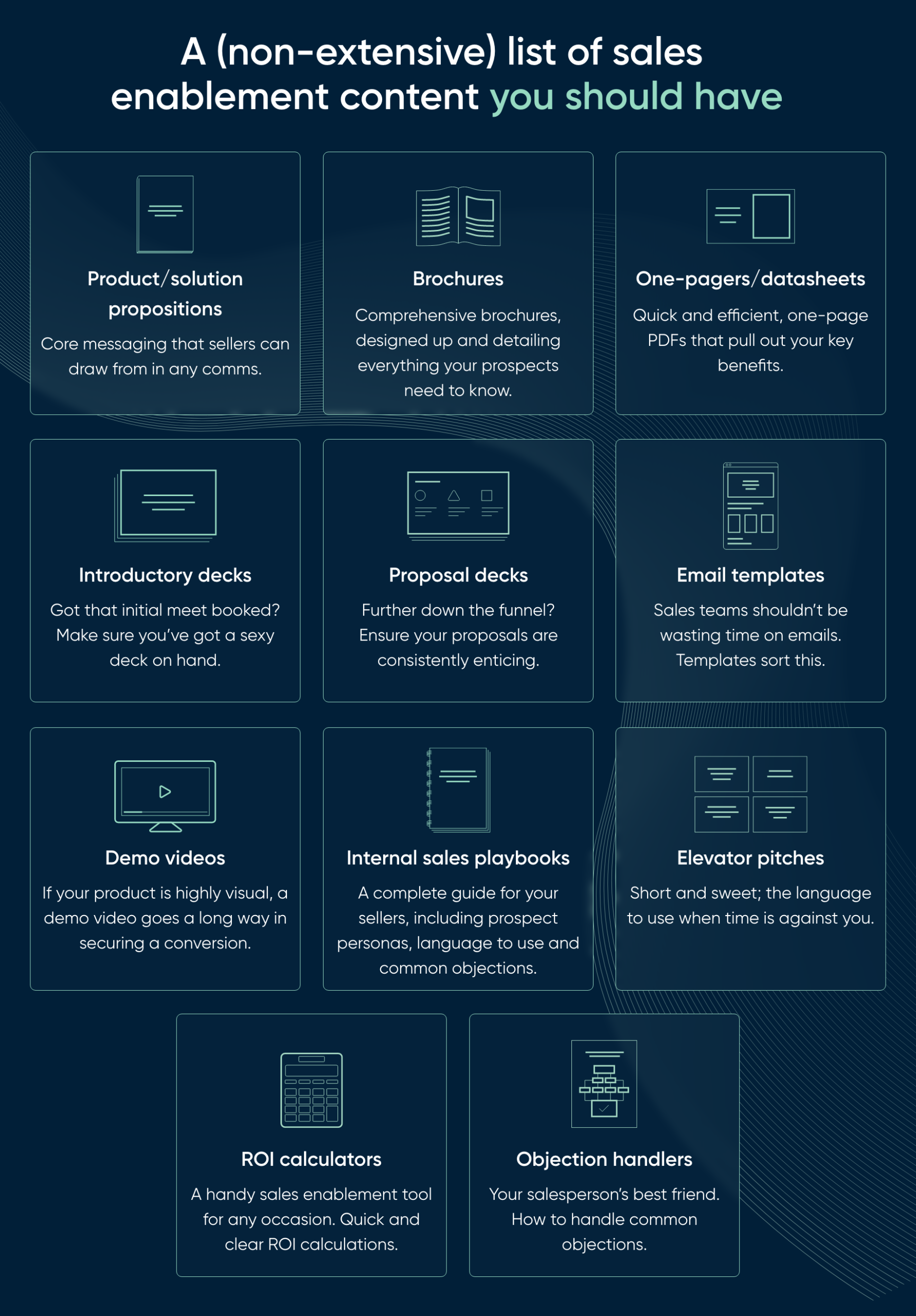
Your sales enablement content should be highly personalised to your unique business and unique buyers. It should address customer pain points and effectively demonstrate your value.
Many salespeople don’t have the time to produce high-quality sales aids, which is why we recommend talking to a sales enablement agency for content support. Want to talk to a sales enablement strategy professional? Use the link below to book a no-obligation chat directly:
7 Reasons You Need Better Sales Enablement Tools & Content
Now onto the meat – the reason you’re here. This is what proper sales enablement tools allow you to do:
1 – Increase conversion rates
Let’s start this list with the one you’re really interested in. A good sales enablement strategy has a direct positive effect on your conversion rates. A big one.
According to HubSpot, organisations with dedicated sales enablement see a 49% win rate on forecasted deals, compared to 42.5 % for those without.
A 6.5% difference may not seem significant, but, in most instances, it results in an increase in revenue of 6-20%.
We’ll get into the other benefits in a moment, but let’s just reiterate: getting your sales enablement strategy right can increase your revenue by up to 20%! If that’s not a compelling benefit, I don’t know what will do it for you!
2 – Project a consistent brand
Brand consistency is essential.
When salespeople use outdated collateral, inconsistent messaging or ad-hoc documents, prospects may receive a different experience depending on the rep they talk to, which erodes trust.
With a strong sales enablement strategy and high-quality content, you ensure that every interaction reinforces your brand’s credibility, tone and promise. By creating a suite of sales enablement tools that your team can use, you can be confident that the assets being delivered to your prospects reflect your brand, not the individual who threw it together.
We recommend having a look through the sales decks and collateral your sales team are sending out right now. Compare them between reps; chances are you’ll find some big differences.
This isn’t their fault. If they’ve not been provided with content, they’ll naturally create it themselves. It’s up to you to give them what they need so that they can ensure your brand is consistent across all comms.
3 – Engage, inform and build trust with your prospects
Buyers are much more shrewd and well-informed than they used to be.
Where, historically, a wily salesperson could “sell sand at a beach”, that won’t fly anymore. Prospects do their research, expect relevant insights, and want to feel they are dealing with professionals. A strong sales enablement strategy ensures that your sales team can deliver persuasive, valuable content at every touchpoint, effectively building trust and credibility.
In fact, 75% of B2B buyers prefer a rep-free experience. People don’t want to feel like they’re being sold to. Sales enablement content allows your reps to be slightly more hands-off, ensuring that, when they do have conversations with prospects, they’re high-quality and conversion-focused.
Using the right sales enablement tools allows your sales team to engage meaningfully. They move away from just pitching, instead becoming advisors who inform and consult. When a prospect feels heard and understood, they’re far more likely to choose you.
4 – Move prospects through the funnel faster
Stuck prospects slowing your sales cycle down? You’re not alone.
A comprehensive sales enablement strategy helps to accelerate those stages by giving reps the content and tools to move prospects through the funnel.
Highspot’s Sales Enablement Analytics Report found that organisations that are “leveraging sales enablement technology” report a “lower amount of deals lost to no decision”.
Sales enablement content helps to reduce friction throughout your pipeline, speeding up follow-ups and making your objectives clear to the prospect.
Basically: better content = fewer delays = faster revenue. That’s the kind of equation we can get behind!
5 – Demonstrate that your salespeople know what they’re talking about
Prospects, much like wolves, can smell fear. They know when you’re uncertain.
If a rep fumbles, lacks relevant proof or collateral, or uses generic content, it makes prospects lose confidence in your brand.
A good sales enablement strategy emphasises credible, professional assets: polished decks, updated data-sheets, case-studies with measurable outcomes, etc. These allow sellers to walk into conversations with authority.
As part of our sales enablement process, we’ll create internal reference docs, detailing the things sales teams must know, how they should talk, and how to handle objections. This should, in practice, mean they’re caught out less, and appear more prepared and professional at all times.
6 – Save on admin time
Only 28% of seller time is spent on actual selling. That’s approximately 582 hours per year selling, out of about 2,080 hours.
Big chunks of time are currently dedicated to content, preparing decks, rewriting collateral, chasing prospects. Bumpf: a waste of time.
By having a suite of sales enablement tools ready and accessible, you cut out almost all of the manual slog that sellers hate.
Less admin time means more selling, better productivity, better morale and less burnout. When you’re measuring the success of your sales enablement strategy, time saved must be a KPI.
7 – Remove friction; make it easy to buy from you
Buying from you should be easy.
If your sales process is clunky and the next steps uncertain, your prospects will hesitate. You want to avoid hesitation at all costs; it kills deals.
Effective tools like ROI calculators, proposal templates and demo videos, coupled with clear instructions on what comes next, can make all the difference. When you make it easy for prospects to understand value and to say yes, you win more deals. That’s what happens when you’ve got a mature sales enablement strategy.
How to create great sales enablement content
You have two options when it comes to creating sales enablement content:
1. Do it yourself
If you have the time and resources available, writing and designing your own sales collateral is a great way to get your sales enablement content off the ground.
Ensure that you:
- Consider your brand at every stage (keep it consistent).
- Carefully craft your copy to ensure it uses balanced language.
- Use design best practices to make your collateral easier to understand.
- Talk to every member of your sales team to discover what messaging works best in the sales process.
- Ensure you understand the market and your unique buyer personas.
2. Speak to the sales enablement experts
Don’t have the time and resources available to do it yourself? Don’t worry, that’s very normal.
We recommend talking to a sales enablement agency; a team of designers, copywriters and strategists that specialise in creating high-quality sales aids and other collateral.
At Catalyst, we work closely with our clients’ sales teams. By analysing existing content, assessing messaging from across your industry and liaising with your salespeople, we create seriously good sales collateral – content that your salespeople are proud to send to prospects.
The sooner we get started, the sooner your salespeople can improve their conversion rates, and the sooner you can accelerate your business’ growth.
Get in touch with our specialists today for a no-obligation chat about improving your sales collateral.