

Many businesses are making the same significant mistake.
They’re assuming that if someone sees their content, that’s a win. That if people scroll past their ad, notice their brand name, or spend 90 seconds on their landing page, they’ve done their job.
Does this sound familiar?
Well, here’s the truth: not all attention is created equal.
This is the core message in McKinsey’s latest research, The Attention Equation. It’s a brilliant, data-driven piece backed by an in-depth survey of 7,000 consumers worldwide. It challenges the marketing world’s obsession with quantity of attention, arguing that we must shift the focus to quality instead.
And we love it.
For over a decade, we’ve preached about vanity metrics – stats that look good on paper, but don’t deliver any tangible ROI. This article reinforces this message: less is more when it comes to marketing. A smaller volume of high-quality, engaged leads is almost always better than the opposite.
McKinsey’s central message is this: consumer attention is now the scarcest and most valuable resource in digital marketing. In an increasingly fragmented landscape (with over 40% of US media hours spent on digital), brands must be laser-focused not just on getting attention, but on winning the right kind of attention at the right time. This is just as applicable to the UK market as it is to the US market.
If you’re a business leader trying to cut through the noise and get genuine traction with your audience, this is essential reading. But if you don’t have time for the full McKinsey treatment, don’t worry, we’ve summarised the key points, added context, and pulled out what really matters for owners, marketers, and commercial leaders alike.
What is the “attention equation”?
At the heart of this equation is a formula:
CQ (commercial quotient) + AQ (attention quotient) = £/hour viewed
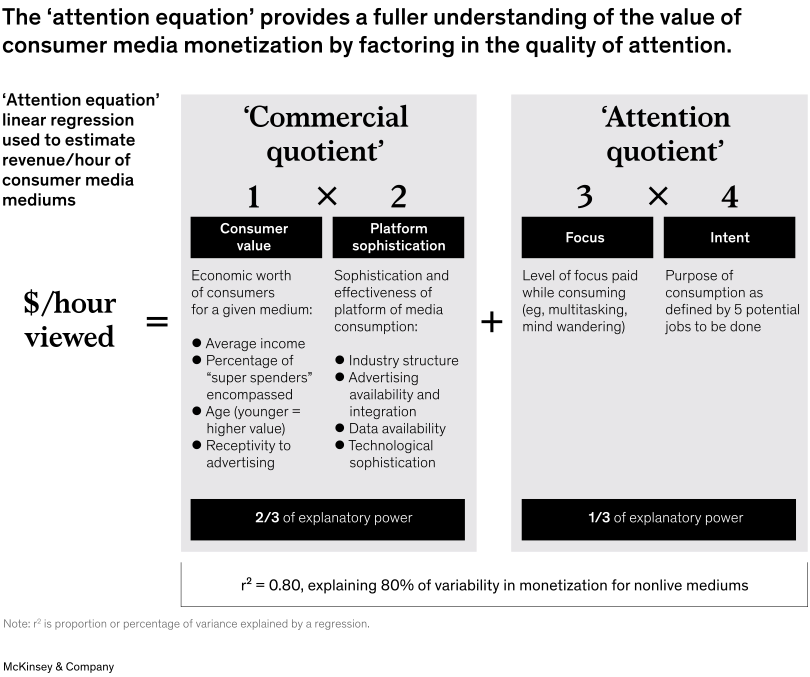
…It’s a little complicated, here’s a simplified version:
It’s not just who sees your content. It’s how focused they are, why they’re there, and how good the platform is at turning that moment into money.
If you’re investing in marketing, this model tells you:
- You can’t just buy eyeballs. You need to buy the right kind of attention. Attention that’s focused and intentional.
- Platforms matter. Being on Instagram and YouTube is more valuable than a basic blog if they allow for better targeting.
- Your content must match what people are there to do. An ad won’t work if it interrupts someone who isn’t looking for what you offer.
Your commercial quotient makes up two-thirds of the reason why one media type earns more money than another. It takes into account how receptive and wealthy your consumers are, as well as the platforms that they’re using (and what they allow you to do).
It’s, in essence, all about the traditional levers of monetisation. Think consumer value, platform maturity, content scarcity, and industry structure. It’s the commercial common sense that marketers should already have.
Your attention quotient is the final third; the missing piece. It captures the quality of attention – how focused people are when they engage, and why they’re tuning in.
Are they multitasking, or truly dialled in? Are they killing time, or looking to solve a problem? This kind of attention is what really drives monetisation, and it’s been overlooked for too long.
Together, they form the attention equation. It’s a smarter way to understand and predict the true value of consumer time.
Do you need to work this out? No, not necessarily. But understanding its principles is important, and paying attention to how you’re marketing (and who you’re marketing to) is critical in modern marketing success.
That makes sense. So, what’s the problem?
This all sounds great, right? A formulaic answer to marketing and growing your business.
Brilliant.
Well… not so much. Unfortunately, the total amount of attention available isn’t growing. Media consumption has already hit its ceiling. McKinsey estimates the average person in developed markets spends around 13 hours a day consuming media. That’s everything from Netflix to email to podcasts.
However, you’re not going to find new hours in the day.
And while content supply is exploding, audience capacity isn’t. Which means you’re not just fighting competitors, you’re fighting everything else for those precious seconds of focus.
The implication? You can’t win just by making more noise. You have to be more precise. More strategic. More relevant.
The first step? Identifying who’s actually worth targeting
Not all consumers are equal, and McKinsey’s research backs that up.
They’ve identified seven distinct types of media consumers, but only three segments consistently deliver high attention and high value:
1. “Content lovers”
These are your curious, information-hungry, multi-channel people. They represent 13% of all consumers. They spend 2.4 times more money on content and consume 1.7 times more content than average.
They’re watching, reading, listening, and engaging with intent. They actively seek out value and will reward quality content with loyalty and conversion. If you can engage with them, you’ll likely have a fan for life.
2. “Interactivity enthusiasts”
Think gamers and creators – the hands-on crowd. This makes up 16% of the consumer base. They love video games, sports, online betting, and comedy.
They’re not just watching, they’re participating. This group wants to be part of the experience. When you meet them where they are, their engagement levels (and spend) are unmatched. They prefer endorsements to advertisements (think influencer marketing), and they spend a good amount of time on online message boards (such as Reddit).
3. “Community trendsetters”
These are the cultural drivers: being very socially connected, highly influential, and deeply engaged in shaping what others see, buy, and believe. They make up 10% of consumers.
If you win their attention, you win access to their networks.
Together, these three groups represent the top 40% of attention-rich, commercially valuable audiences. The rest? Lower engagement, lower return, and higher acquisition costs. Here’s McKinsey’s visual breakdown of the consumer attention segments:
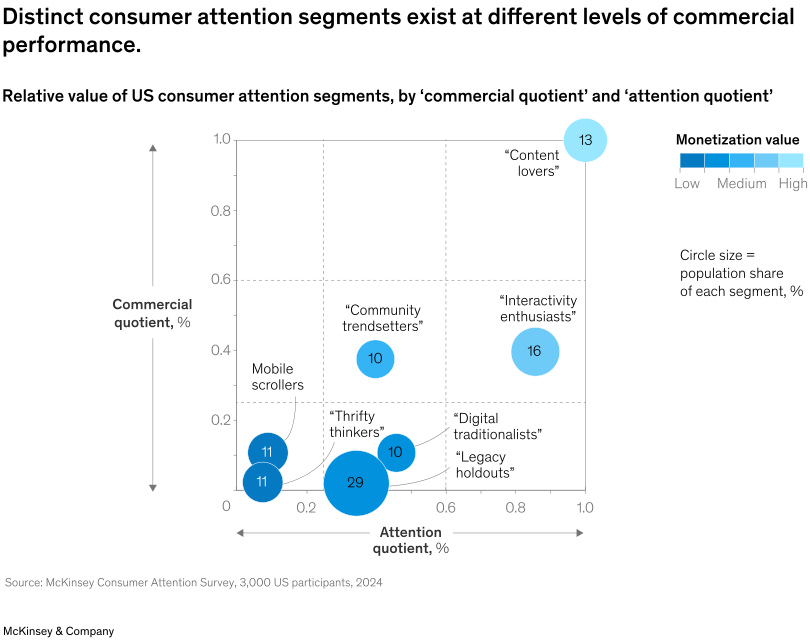
As you can see, “Content lovers” are far more likely to be profitable. The higher the engagement levels, the higher the spending power, the more successful the marketing.
So… What should you do with this information?
Stop chasing reach, start chasing relevance
Eyeballs are easy to buy. Platforms like Meta and Google will sell you thousands of impressions for pennies. But if you’re targeting the wrong people, or reaching them at the wrong moment, you’re pouring budget into a black hole.
What to do:
Audit your paid media and organic content strategy. Are you optimising for attention quality or just quantity? Are you interrupting someone mid-scroll, or meeting them when they’re actively looking for what you offer?
2. Get ruthless about audience value
It’s time to stop thinking about “target audiences” as broad demographics and start thinking in terms of jobs to be done. What’s the user’s mindset when they engage with your brand? Are they trying to solve a problem? Learn something? Make a decision?
What to do:
Rebuild your personas based on behaviour and intent. Layer in qualitative research. Look at who’s converting, not just who’s clicking. Take the time to identify who you really want to sit down with, then tailor your marketing from there.
3. Prioritise contextual fit over blanket coverage
There’s a world of difference between an ad seen during a podcast about business growth and the same ad flashing up during a TikTok dance. Same cost, wildly different impact.
What to do:
Map where your audience is most focused and intentional. Then align your content, creative, and budget around those moments. If you meet your audience at the right place, at the right time, and when they’re most engaged, you’ll see better results.
4. Explore undervalued attention channels
McKinsey highlights mobile gaming and audiobooks as prime examples of channels where attention is high, but ad costs are low. This is largely because they’ve been overlooked by traditional marketers.
What to do:
Test placements in unexpected channels. If your target audience spends time in immersive, underpriced environments, get in early. First-mover advantage still matters.
Remember: much of marketing is experimentation. Try a channel out, measure your results, iterate where necessary, and abandon if you see no ROI.
If you’re not already, bring digital PR into your marketing mix. This acts as a sort of “credibility engine”, designed specifically to strengthen your organic reach and improve the quality of the attention your brand is generating.
5. Shift your metrics
This is the tough one. But if you’re still reporting success based on impressions, bounce rate, or clicks, you’re not measuring the thing that really moves the needle.
What to do:
Build a new measurement framework around attention quality. Include metrics like time on page with interaction, scroll depth, replay rates, engagement with CTAs, and qualitative intent signals. Better yet, tie marketing metrics directly to business outcomes, that’s leads, conversions, and LTV (lifetime value).
There’s a lot that needs to change, and not a lot of time in the day
Every business has a finite budget, but your audience has a finite attention span. The latter is the more important constraint.
Winning attention, that’s real, focused, intentional attention, isn’t about spending more. It’s about spending smarter; choosing your battles, and focusing on quality over quantity.
We’re with McKinsey on this one: the brands that learn how to attract and convert valuable attention will be the ones still standing in five years’ time.
Counting likes is fun, but it doesn’t grow a business.
If you’re reading all of this and you’re not sure where to start, don’t worry – many business leaders are in the exact same position as you.
The first step is getting some expert marketing resource in your corner, and it just so happens that you’re in the perfect place for that.
We are Catalyst, a commercially focused digital marketing agency that focuses on business growth and ROI. We’ve been following these principles for years; the industry is finally catching up.
The first step is a no-obligation chat with our marketing professionals. We’ll talk through your business, objectives, what’s worked, what’s not, etc. It’s a quick chat – you’ve got a lot to gain, and nothing to lose.