A growing number of your potential customers have stopped searching and started asking questions. For example, rather than typing “accountants in the West Midlands” into Google and scrolling through the results, they’re asking ChatGPT (often using their voice to ask the question directly) and getting a comprehensive, written-out answer, usually with a shortlist of recommendations.
The scale of the shift is mind-boggling.
Ofcom’s latest Online Nation report found that ChatGPT received 1.8 billion visits from UK users in the first eight months of 2025, nearly five times the figure for the same period the year before. In February ’26, OpenAI announced that more than 900 million people now use it every week.
Now, if you’re reading this, you’re likely a business owner or a leader in your field, and you’re thinking the same question as everyone else in your position: “How the **** do I get ChatGPT to recommend us?”
It’s like the Wild West out here; every marketer is scrambling to meet the new demand for AI search optimisation, but for the most part, people are working on assumptions rather than real guidance from the companies building the tools. It’s a whole lot of guesswork dressed up as fact.
In this article, I’ll run through what we know for certain, what nobody knows yet, and where your money is best spent.
What is AI search?
AI search is basically SEO for AI tools. It’s how we help get your content found by ChatGPT and other tools, in addition to traditional search platforms like Google.
The big AI tools we’re talking about are ChatGPT (built by OpenAI), Gemini (Google), Claude (Anthropic) and Perplexity. You can add Google’s AI Overviews to that list too: the AI-written summaries that now sit at the top of around 30% of UK searches, whether you asked for one or not.
Under the bonnet, these tools combine two things: a large language model (the AI itself, trained on enormous amounts of text) and, increasingly, live web search, which lets the tool look things up before it answers. So, when ChatGPT recommends four accountancy firms in the West Midlands for you, that information usually comes directly from a traditional search engine. These are pages the model was trained on, pages it retrieved seconds ago, or a blend of both.
This is why you now need to rank both in AI search and traditional SEO, because AI is now doing the searching for many people.
Why did traditional SEO work on every platform?
Historically, you’d probably use either Google or Bing. But regardless of your platform of choice, they all work the same way:
- The search engine’s software visits your website and reads it (crawling)
- It files what it finds on your website (indexing)
- It then decides which pages best answer queries people are searching for (ranking)
- The better your content, the more likely you are to rank at the top of the list
Google, Bing and the others weigh things slightly differently, but they all pretty much use the same rulebook to decide what ranks and what doesn’t: useful content, a technically sound site, relevant keywords, links from reputable websites and a decent experience for the person visiting.
“Pretty convenient that they all work the same way”. Well, yeah – it was intentional.
In 2006, Google, Yahoo and Microsoft jointly agreed to support a single sitemap standard (a file that tells search engines which pages your site contains).
In 2011, the same companies launched Schema.org, a shared vocabulary for labelling content so machines can understand it. The search engines built common standards together, which is why advice from one applied to all of them.
Optimise properly for Google, and you have, in effect, optimised for everyone. This means we’ve got 20 years of search engines playing nice together, and now AI platforms have barged in, messed the house up, and are refusing to tidy up.
Why AI platforms don’t play by the same rules
In short, every AI platform has been built in isolation from others, and there is no agreement between organisations on how they should function.
They learn from different libraries. Every model is trained on its own mix of websites, books and licensed data, so no two share the same underlying knowledge of your industry, or of you.
They look things up differently, too. Each platform runs its own web crawlers under its own rules and uses its own retrieval system to decide which live pages are worth consulting when someone asks a question.
And after training, each AI company tunes how its model behaves: what counts as a good answer, how cautious to be, and when to cite a source. Two AI tools can read the same page about your business and describe it quite differently.
Profound, a firm that tracks which websites AI tools reference, analysed 680 million AI citations and found that only 11% of the web domains cited by ChatGPT were also cited by Perplexity for the same prompts.
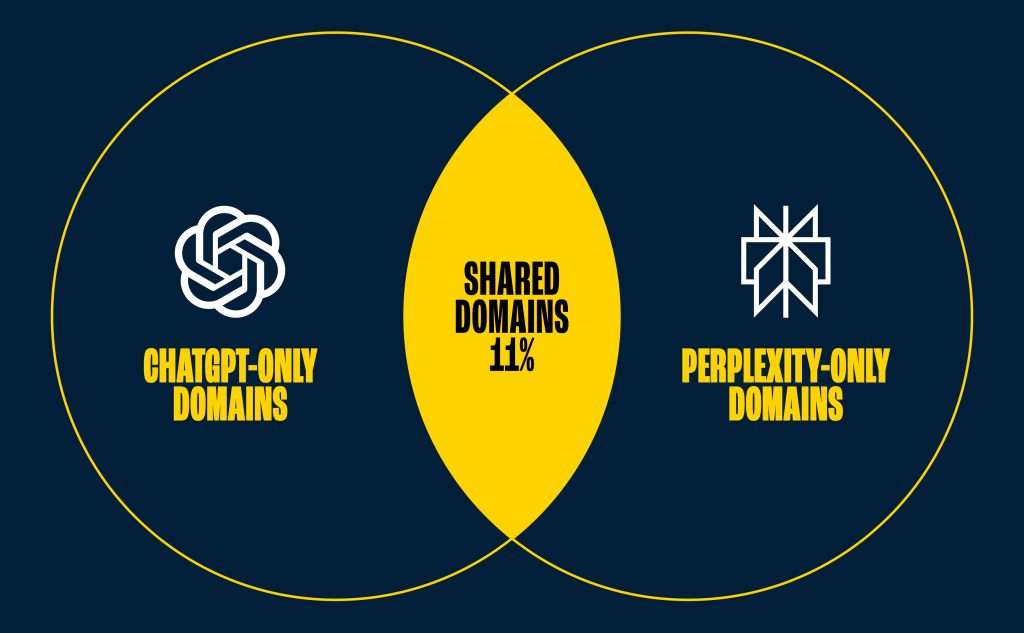
This means that optimising for one AI tool doesn’t mean you’re optimising for them all.
Any marketer who tells you otherwise is either misinformed or lying.
So, can you optimise for ChatGPT?
If you clicked on this blog, this is the bit that you’re here for. The truth is that “ranking” in ChatGPT is a completely different thing from optimising for Google.
There are no published ranking factors, no reliable position tracking, no official guidelines explaining what the platform rewards, and no universal set of GEO best practices. While many agencies (us included) are now optimising content for AI tools, we can’t guarantee results. It’s a brand new facet of SEO that we’re still learning new things about.
What we can do is improve your odds across every AI platform by focusing on what they seem to value in common. We’ve had success with our own website and with our clients’ by:
Publishing content that demonstrates real expertise
AI tools synthesise what credible sources say. Generic pages give them nothing worth repeating, whereas detailed answers from people who clearly know the subject do.
Build depth on your specialist topic
A site with fifteen substantial, interlinked pages on commercial flooring reads as an authority on commercial flooring; a single page is unlikely to. We call this “topical authority”.
Get mentioned beyond your own website
Reviews, trade press, directories, supplier pages and industry forums all feed AI systems. What others publish about you is just as important as what you publish yourself, which is why digital PR has become essential for SMEs in the last few years.
Keep your site clear and machine-readable
Straightforward headings, direct answers to the questions customers ask, and structured data (behind-the-scenes labels that make it clear what your business is, does and sells) all make your content easier for AI tools to parse.
If that list sounds familiar, it should. It’s a list of SEO best practices.
3 things you should be doing to improve your AI search performance
Keep investing in SEO
Google still handles the overwhelming majority of UK searches, and its AI Overviews are assembled from its ordinary search index, so ranking well remains the most reliable way into them. The content that earns rankings demonstrates expertise, authority, and technical quality; it’s largely the same stuff that earns AI citations.
Abandoning SEO to chase AI visibility would mean giving up the channel where we know exactly how it works to gamble on several that have no set-in-stone rules.
AI search is all about quality over quantity. You’re not going to be driving the same volume of traffic that you used to, because people who get their answers inside ChatGPT rarely click anything. The visitors that do arrive, though, enter your site unusually well informed and closer to a decision, meaning you need to ensure that your website is equipped and ready for conversion when this happens.
Semrush research found the average visitor from an AI search converted at 4.4 times the rate of a traditional organic search visitor.
Give AI something it can only get from you
These systems summarise what already exists, so content that repeats what every competitor says gives them no reason to mention you. Original data, first-hand experience, transparent pricing information and a clear point of view are far more valuable than regurgitating the same things your competitors are saying and hoping that you’ve said it better.
And remember – nothing in AI search is certain. Things are changing on a monthly, even weekly basis. AI platforms publish next to nothing about how they work, which means no marketing agency can guarantee AI search results.
Continue building your brand authority
AI tools will disproportionately favour authoritative brands, which means the domain authority you’ve been building over years is now more important than ever.
It’s basically like waving a great big flag that shows AI tools you’re the business with the answers. To build your digital authority, you should be:
- Creating thought leadership content that people want to read and reference
- Prioritise digital PR to ensure your brand appears outside of your website
- Build a backlink strategy that encourages high-authority websites to link to yours
Unfortunately, there isn’t a magic fix-all AI checklist. Fortunately, many of the traditional SEO best practices we’ve been honing for years are still very, very relevant.
At Catalyst, we build search strategies that perform in traditional search engines while simultaneously earning mentions in AI answers. Yes, we’ve split things up into SEO, GEO and AEO, but we’ve done this as a best practice (remember our point earlier – “Build depth on your specialist subject” – that’s exactly what we’re doing with our Search pages).
While we never guarantee results, what we can do is show you, demonstrably, where our approach has worked, before outlining the best possible route you can take to improve your AI search rankings.
It all starts with a quick chat; shall we book you in?